

 Live Chat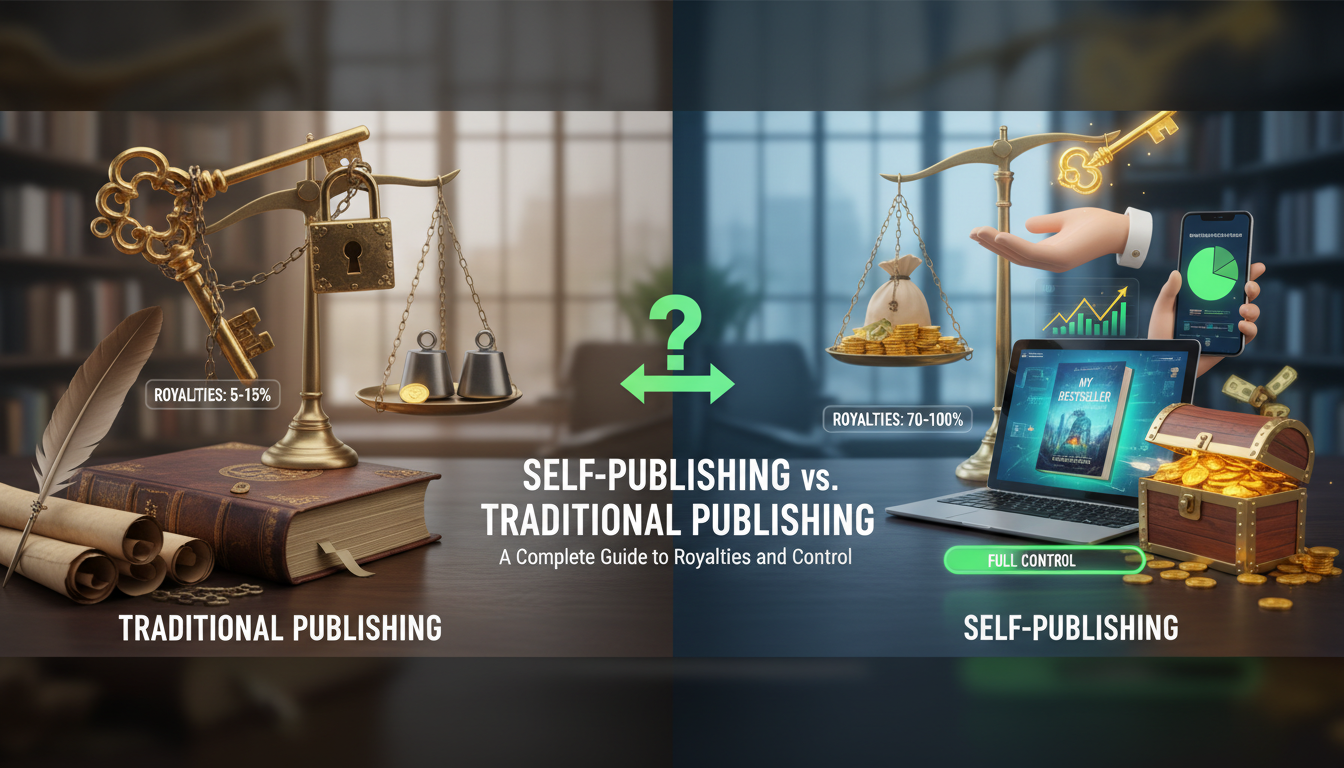
Introduction
For decades, the path to becoming a published author was singular, narrow, and heavily guarded. You wrote a manuscript, queried literary agents, faced a barrage of rejection letters, and hoped that eventually, a traditional publishing house would deem your work worthy of shelf space. Today, the landscape of the publishing industry has undergone a seismic shift. The democratization of distribution through digital platforms has turned self-publishing vs. traditional publishing into a strategic business decision rather than a choice of last resort.
Authors now face a complex crossroads. On one side lies the prestige, distribution networks, and validation of traditional publishing. On the other stands the autonomy, speed to market, and higher royalty potential of self-publishing. For thought leaders, business executives, and aspiring novelists alike, understanding the nuances of royalties and control is paramount to maximizing the value of their intellectual property.
This comprehensive guide delves deep into the mechanics of both publishing models. We will strip away the myths surrounding "vanity presses" and the "gatekeepers" of New York to provide a transparent look at the financial realities, creative rights, and long-term implications of your publishing choice. Whether you are looking to build authority in your niche or launch a fiction career, choosing the right vehicle for your book is as critical as writing the book itself.
Understanding the Core Models: Defining the Players
Before analyzing the financials, it is essential to define exactly what we mean by the two primary models in the modern era. The lines have blurred slightly with the rise of hybrid publishing, but the two poles remain distinct in their operations and legal structures.
The Traditional Publishing Ecosystem
Traditional publishing refers to the established system where an author sells the rights to their work to a publishing house. This usually involves the "Big Five" publishers (Penguin Random House, HarperCollins, Simon & Schuster, Hachette, and Macmillan) or mid-sized independent presses. In this model, the publisher assumes the financial risk. They cover the costs of editing, cover design, formatting, printing, and distribution. In exchange, the author signs over exclusive rights to the work and receives a percentage of sales (royalties), often preceded by an advance.
The Self-Publishing (Indie) Ecosystem
Self-publishing, or independent publishing, places the author in the role of the publisher. You effectively become the CEO of your book’s startup. You retain all rights to your work but are responsible for sourcing and funding every stage of production—from developmental editing and proofreading to cover design and marketing strategy. Platforms like Amazon Kindle Direct Publishing (KDP) and IngramSpark facilitate distribution, but the author bears the financial risk and reaps the majority of the reward.
Deep Dive: The Battle for Creative Control
One of the most significant points of friction in the self-publishing vs. traditional publishing debate is the issue of control. For many authors, a book is deeply personal, a manifestation of years of thought and effort. How much of that vision are you willing to compromise?
Creative Autonomy in Self-Publishing
If you choose to self-publish, you maintain 100% creative control. You select your editor, you approve the final cover design, and you choose the title. This is particularly attractive for business authors who need their book to align strictly with existing corporate branding or specific marketing funnels. If you want to release a 50-page manifesto or a 500-page technical manual, no market committee can tell you it doesn’t fit their current catalog.
However, total control requires total responsibility. The freedom to design your own cover can lead to amateurish results if not managed by professionals. Successful indie authors act as project managers, hiring top-tier talent to ensure their product rivals those produced by major houses.
The Trade-offs of Traditional Publishing
When you sign a traditional publishing contract, you are essentially partnering with a team of experts who have a vested interest in the book’s salability. While this expertise is valuable, it comes at the cost of autonomy. Publishers frequently change titles to optimize for market trends. They have the final say on cover art, often overruling the author’s preference in favor of what their sales teams believe will appeal to retailers.
Furthermore, editorial control can be strict. While a good editor polishes your voice, there are instances where publishers may request significant structural changes to make a book more "commercial." For authors who are protective of their specific message or narrative structure, this loss of control can be a significant pain point.
The Financial Breakdown: Royalties and Advances
The economics of publishing are often misunderstood. Many aspiring authors equate a traditional book deal with instant wealth, while others view self-publishing as a path to pennies. The reality is far more nuanced and depends heavily on volume, pricing strategies, and format.
Traditional Royalties: The Slice of the Pie
In traditional publishing, the author receives a royalty based on the sale of each book. Standard industry rates hover around:
- Hardcover: 10% to 15% of the list price.
- Trade Paperback: 7.5% to 10% of the list price.
- Mass Market Paperback: 5% to 8% of the list price.
- E-books: 25% of the net receipts (what the publisher receives from the retailer).
It is crucial to understand the concept of the Advance against Royalties. A publisher may pay you an upfront sum (e.g., $10,000 or $50,000). You will not receive another check until your accumulated royalties exceed that advance amount. Many books never "earn out" their advance, meaning the author never sees a royalty check beyond the initial payment.
Self-Publishing Margins: The Volume Game
Self-publishing flips the economic model. Because you are not supporting the overhead of a large corporation, the platforms pass a significant portion of the revenue back to you. Standard rates on major platforms include:
- E-books: Generally 70% of the list price (for books priced between $2.99 and $9.99).
- Print Books: Approximately 60% of the list price, minus the cost of printing.
To visualize this: selling a traditional e-book at $10 might net the author $1.75 (25% of the 70% the publisher gets). Selling a self-published e-book at $10 nets the author $7.00. This means a self-published author can sell significantly fewer copies to generate the same income as a traditionally published author. However, the self-published author must recoup their initial investment in production before reaching pure profit.
Time to Market: Speed vs. Strategy
In the digital age, speed is a currency. The timeline differences between the two models are stark and can be a deciding factor for timely non-fiction or business books.
The Traditional Slow Burn
Traditional publishing is a slow-moving machine. Once a manuscript is acquired, it typically takes 18 to 24 months to reach bookstores. This timeline accommodates the catalog cycles, editorial back-and-forth, advanced review copy distribution, and pre-order sales campaigns. For a novel, this might be acceptable. For a book on technology trends or current political analysis, a two-year delay can render the content obsolete before it hits the shelves.
The Agility of Self-Publishing
Self-publishing allows for rapid deployment. A motivated author can move from a finished manuscript to a live listing on Amazon in under three months, provided they have lined up their editing and design team in advance. This agility allows authors to capitalize on current events, trends, or immediate business opportunities. If you are using a book as a lead magnet for a speaking tour scheduled in six months, self-publishing is often the only viable option.
Distribution and Shelf Space: The Reality Check
The allure of seeing one’s book in a physical bookstore window is a powerful motivator for pursuing traditional publishing. This is an area where traditional publishers still hold a distinct advantage.
The Power of Brick-and-Mortar
Traditional publishers have dedicated sales teams that pitch titles to book buyers at major chains (like Barnes & Noble), independent bookstores, and big-box retailers (like Target or Walmart). They handle the logistics of returns—a critical aspect of the physical book trade. Retailers are hesitant to stock books that they cannot return if unsold. Because traditional publishers accept returns, bookstores are willing to give their titles shelf space.
The Online Dominance of Indies
While self-published authors can get into bookstores (usually through consignment or by using IngramSpark with a returns option enabled), the battle is uphill. However, the modern book market is increasingly digital. With over 50% of book sales happening online (and a much higher percentage for e-books), the lack of physical shelf space is less detrimental than it used to be. For niche non-fiction, the target audience is searching via keywords on Amazon, not browsing the aisles of a local shop.
Marketing Responsibility: Who Does the Heavy Lifting?
Perhaps the most pervasive myth in publishing is that signing a traditional deal absolves the author of marketing duties. This is rarely the case for debut authors or mid-list titles.
The Traditional Marketing Mirage
While a publisher will list your book in their catalog and may send review copies to trade publications (like Kirkus or Publishers Weekly), they expect the author to drive sales. Publishers invest their limited marketing budget in their lead titles—the top 5% of books they expect to be blockbusters. If you do not have an existing platform, social media following, or email list, a traditional publisher will expect you to build one.
The Necessity of Self-Promotion
In self-publishing, the burden is entirely on you, but so is the control over the data. You can run Amazon Ads, Facebook campaigns, and price promotions (like discounting an e-book to $0.99 to drive rank) at will. A traditionally published author usually cannot lower the price of their book to spur sales without the publisher’s consent. Regardless of the path chosen, the modern author must be a marketer.
Quality Control and Credibility
Historically, traditional publishing acted as a vetting mechanism. A book with a major imprint stamp signaled quality. This "gatekeeper" effect still holds weight, particularly in academia and literary fiction reviews. Being published by a recognizable house can open doors for speaking engagements and media appearances more easily than a self-published title.
However, the stigma of self-publishing has eroded significantly. High-quality indie books—professionally edited and designed—are indistinguishable from their traditional counterparts. The key lies in execution. A self-published book that cuts corners on editing or cover design reinforces the stigma, while a professional product builds the author’s brand just as effectively.
Making the Decision: A Strategic Framework
To decide between self-publishing and traditional publishing, evaluate your primary goals:
- Choose Traditional Publishing If: You seek mainstream literary prestige, you want the highest chance of physical bookstore placement, you do not have the budget to invest in production, and you are willing to wait years for release.
- Choose Self-Publishing If: You want maximum financial return per unit sold, you need the book released quickly (e.g., for a business launch), you want total creative control, or you have a niche audience that is easy to reach directly online.
Both paths require professional standards. Even if you self-publish, consider hiring professional ghostwriters or editors to ensure the manuscript meets industry standards. The quality of the writing is the one variable that cannot be compromised in either model.
Frequently Asked Questions
1. Is self-publishing considered "lesser" than traditional publishing?
In the past, yes, but the stigma has largely faded. Today, the quality of the book matters more than the publisher. Many successful authors, known as "hybrid authors," use both models depending on the project. If the production quality (cover, editing) is professional, readers rarely notice the publisher.
2. Can I self-publish first and then get a traditional deal later?
Yes, but it is rare. This usually happens if a self-published book sells a significant number of copies (typically tens of thousands), proving to publishers that there is a market. For most authors, the rights sold to a publisher will require the self-published version to be taken down and re-released.
3. Do I need a literary agent for self-publishing?
No. Literary agents are the intermediaries between authors and traditional publishers. If you are self-publishing, you are the publisher, so you do not need an agent to represent you. However, you will need to hire freelancers (editors, designers) directly.
4. How much does it cost to self-publish a book professionally?
Costs vary wildly, but a professional quality book typically requires an investment between $2,000 and $5,000. This budget covers professional developmental editing, copyediting, proofreading, cover design, and interior formatting. It is a business investment in your intellectual property.
5. Who owns the copyright in traditional publishing?
The author retains the copyright, but they license specific rights to the publisher. This usually includes the exclusive right to print and distribute the book in certain territories for the term of the contract. The author cannot publish the same content elsewhere while the contract is in effect.
Conclusion
The debate between self-publishing vs. traditional publishing does not have a one-size-fits-all answer. It is a choice between two distinct business models, each with its own risk profile and reward structure. Traditional publishing offers a partnership that trades control and potential income for distribution reach and prestige. Self-publishing offers a path of autonomy and higher margins, demanding an entrepreneurial spirit and upfront investment.
Ultimately, the success of your book depends less on the logo on the spine and more on the quality of the content and the strength of your connection with your readers. Whether you choose to query agents or upload directly to KDP, treat your book as a professional product. Invest in great writing, professional design, and strategic marketing to give your work the audience it deserves.